
Reviewed September 2026. Methodology note: figures below are drawn from Bank of Thailand transaction series, provider-published terms, and peer-reviewed interbank assessments. Where a statistic describes national network scale, it is labeled as such and is not extrapolated to any individual merchant. Thai legal review was obtained before publication.
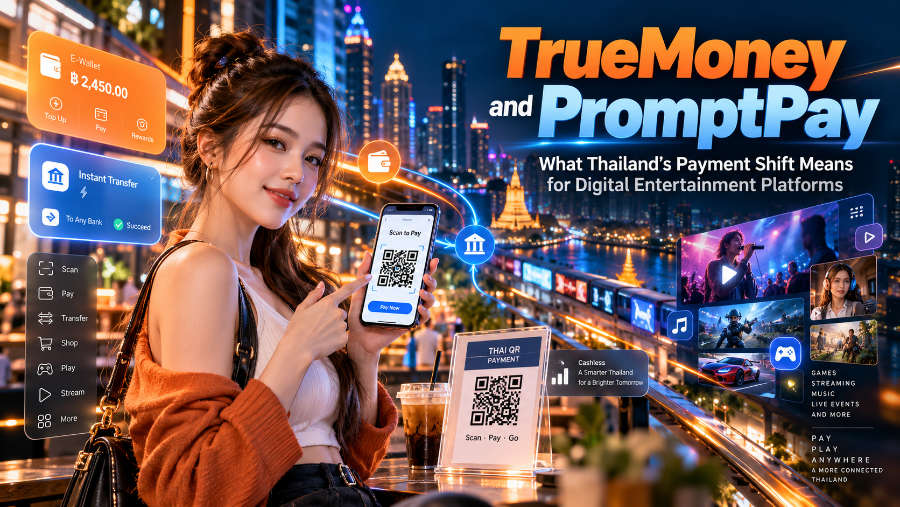
Thailand’s digital-payment rails have become fast enough and familiar enough that consumers routinely move money through a mobile number or a QR scan in seconds. That speed, however, answers only one question—how quickly value settles between two financial institutions. It does not answer whether the receiving merchant is licensed, whether the transaction purpose is permitted under Thai law, whether anti-money-laundering monitoring was applied, or how a disputed transfer is reconciled and resolved. This article treats TrueMoney and PromptPay as a payments-industry case study: a structured examination of where the rails end and the separate questions of merchant eligibility, transaction monitoring, consumer protection, and local regulation begin. TrueMoney’s published terms restrict transactions for unlawful purposes and require identity checks; a payment option appearing on a website does not, by itself, establish that the recipient is authorized to receive funds through that option. The statistics cited below are drawn from the Bank of Thailand’s transaction series, provider-published terms, and interbank assessments; they describe network scale and documented interoperability, not the crediting speed or regulatory standing of any individual digital-entertainment platform.
Why Thai Payments Changed
From Manual Transfers to Mobile-First Payment Experiences
Thailand’s retail payment landscape shifted decisively toward mobile-first initiation over the past decade. The Bank of Thailand’s PromptPay platform—built on the national instant-payment rail—now supports transfers keyed to mobile numbers, national-identity numbers, e-wallet numbers, and bank account numbers. A consumer can scan a QR code or enter a phone number and initiate a real-time account transfer without visiting a branch or completing a paper form. The Bank of Thailand recorded 2.534 billion PromptPay transactions in June 2026 (provisional), a figure that signals the depth of adoption rather than the conversion rate of any single merchant category.
What National Transaction Totals Can—and Cannot—Show
Those June 2026 transactions carried a combined value of THB 4.603 trillion, also provisional. March 2026 registered 2.544 billion transactions worth THB 4.946 trillion. The consistency across months tells us that large monthly volume is not a one-month anomaly. What it does not tell us is how quickly any particular digital-entertainment platform credits a recipient’s account, whether a given merchant is authorized to accept PromptPay-funded payments, or how a failed transfer is reconciled. Network scale and merchant-level performance are separate questions, and this article keeps them separate throughout.
Wallet and Transfer Rail
TrueMoney’s Account, App, and Funding Sources
TrueMoney, operated by True Money Company Limited, provides an e-money wallet accessible through an account and companion application. Its published terms describe funding sources that can include bank transfers, cash top-ups, and other rails. Critically, the terms tie transaction limits to the user’s verification tier and reserve the right to investigate or hold transactions associated with unlawful purposes. A payment option appearing on a website does not, by itself, establish that the recipient is authorized to receive funds through that option.
PromptPay Identifiers and QR-Based Initiation
PromptPay operates at the infrastructure layer. The Bank of Thailand describes transfers using identifiers—mobile numbers, identity numbers, e-wallet numbers, bank account numbers—and supports QR-based initiation where a payer scans a code to route funds to a designated recipient. The QR code encodes the destination; the rail settles the value. Understanding that distinction—QR as routing instruction versus the underlying account-to-account settlement—matters when evaluating speed claims.
Why Transfer Completion and Account Crediting Differ
A transfer can complete at the rail level—funds leave the payer’s account and arrive at the payee’s bank account—while the receiving platform (a digital-entertainment operator, for example) applies its own ledger processing, verification steps, and reconciliation before the customer sees a balance update. Fast transfer settlement is not the same as instant crediting by a recipient platform. The Bank of Thailand’s statistics measure the former; they say nothing about the latter.
The New Trust Threshold
Merchant Eligibility and Permitted Transaction Purpose
TrueMoney’s terms expressly restrict transactions made with unlawful purposes and require identity checks at onboarding and, in some cases, at transaction time. The March 2026 PromptPay value of THB 4.946 trillion provides scale context but is explicitly not evidence that every merchant category is permitted to receive PromptPay-funded payments. Merchant eligibility, permitted transaction purpose, and local licensing remain separate determinations from the mere availability of a payment rail.
Identity Checks, Recipient Verification, and Transaction Monitoring
Provider terms describe investigation-related holds: a transaction flagged for anti-money-laundering review may be paused pending confirmation of the payee’s identity and the purpose of the transfer. The verification tier determines limits; a lower-tier account faces tighter caps than a fully verified one. For digital-entertainment platforms, this means that even where a wallet option is displayed, the underlying transaction may still be subject to recipient verification, transaction monitoring, and, in edge cases, a temporary hold.
Receipts, Failed Transfers, and Customer Recourse
A completed transfer generates a payment receipt. A failed transfer—reversed at the rail or rejected by the receiving institution—triggers a different flow: funds return to the payer, and the receiving platform’s ledger must be reconciled so that no phantom credit appears. Customer recourse in either scenario depends on documented reconciliation data, not on the speed of the original attempt.
An Industry Benchmark
What High-Value Transaction Services Can Learn from Transparent Confirmation
The payments-infrastructure case studies documented below show that transparent confirmation—displaying the recipient name before execution, recording a receipt, and providing a reconciliation trail—reduces dispute volume and builds user confidence. High-value digital-entertainment services that handle prize redemptions or customer-fund movements can adopt the same transparency norms: named payee confirmation, documented approval, and a visible resolution procedure.
Why Speed Must Be Paired with Recipient Checks
The Financial Stability Board’s 2025 assessment of the PromptPay–PayNow corridor found that combined transfer fees and currency-conversion markup fell from an average of 13% before the linkage to under 3% afterward, and that the corridor handled just over 870,000 transfers in 2024, up 16% year-on-year. Speed and cost improved because the underlying rails were interoperable. Yet the FSB attributes those gains narrowly to the studied corridor; they do not generalize to every Thai digital-payment interaction. Speed without recipient checks creates exposure; checks without speed create friction. The benchmark is the pairing.
Case-Study Bridge
Licensed entertainment operators have pioneered transaction-verification frameworks that set a benchmark for high-value digital services. An editorial look at platforms with advanced payout transparency—operators such as LAVA90 (https://lava90.netlify.app/), which publishes its identity-verification tiers, documented approval workflow, and documented resolution procedures alongside its payment options—should assess those controls rather than merely noting the presence of a payment logo. That editorial assessment is proposed anchor copy for a follow-up piece; it is not a claim verified for any destination page at the time of this article’s publication.
Cross-Border Lessons, Local Limits
What the Singapore–Thailand Connection Demonstrates
The Bank of Thailand and the Monetary Authority of Singapore launched the PromptPay–PayNow linkage in April 2021, specifying an initial daily cross-border system limit of THB 25,000 or SGD 1,000. Ravi Menon, then managing director of MAS, called the linkage “a pioneering effort” that demonstrated the potential of existing banking infrastructure for cross-border retail payments. Sethaput Suthiwartnarueput, then Bank of Thailand governor, described it as “another key milestone in our digital payments journey.” The corridor’s documented outcomes—870,000+ transfers in 2024, sub-3% combined fees—illustrate how use cases can carry specific limits and measurable cost reductions.
Why Interoperability Does Not Confer Merchant Authorization
A cross-border rail connection authorizes the settlement path, not every merchant that might appear on a destination site. Interoperability between PromptPay and PayNow does not mean that a Thai digital-entertainment platform is automatically eligible to receive PayNow-funded payments, nor does it waive Thai licensing, anti-money-laundering, or consumer-protection requirements. The scope qualification is essential: the FSB’s corridor gains apply to the studied linkage, not to all Thai digital payments.
What to Verify Before Citing a Specific Provider Partnership
The UnionPay International and National ITMX QR collaboration, announced to let eligible UnionPay-enabled apps scan PromptPay QR codes in Thailand, verifies the arrangement and the intended customer experience. Chatchai Dusadenoad, National ITMX managing director, stated that the collaboration “strengthens Thailand’s digital payment ecosystem by enhancing the reach and usability of PromptPay QR Code.” However, the retrieved source does not establish a measured post-launch transaction outcome. Before calling any partnership a quantified success, obtain the post-launch data. Apply the same discipline to every provider partnership cited in editorial copy.
Frequently Asked Questions
What is the difference between TrueMoney and PromptPay?
TrueMoney is an e-money wallet operated by True Money Company Limited; it provides an account and app that can draw on several funding sources and is subject to verification-tier limits. PromptPay is the Bank of Thailand’s national instant-payment rail; it routes transfers using identifiers such as mobile numbers, identity numbers, e-wallet numbers, and bank account numbers. TrueMoney may fund a transfer; PromptPay settles it. They operate at different layers and should not be conflated.
Are PromptPay transfers instant?
The rail is designed for real-time settlement. The Bank of Thailand recorded 2.544 billion PromptPay transactions in March 2026, confirming sustained high-volume operation. “Instant” describes the rail’s settlement architecture; it does not guarantee that a receiving platform credits a customer’s ledger account within the same second. The speed question applies to the rail, not to any individual merchant’s back-office processing.
Does a successful transfer mean an account balance updates immediately?
No. A successful transfer means the rail completed settlement between two financial institutions. The receiving platform then applies its own verification, reconciliation, and ledger-crediting steps. A gap between rail completion and visible balance update is normal and does not indicate a failed transaction.
What checks apply to TrueMoney transactions?
TrueMoney’s published terms require identity verification at onboarding, tie transaction limits to the user’s verification tier, and reserve the right to investigate or hold transactions associated with unlawful purposes. Anti-money-laundering controls and recipient-confirmation steps may apply at transaction time, particularly for higher-value transfers.
Does payment-method availability establish a service’s authorization?
No. A payment logo or option on a website indicates that the site offers that rail as an input method. It does not establish that the recipient is licensed, that the transaction purpose is permitted under Thai law, or that the provider has approved the specific merchant. Merchant eligibility and local licensing are separate determinations.
Conclusion
Payment infrastructure can reduce friction. Authorization, recipient checks, reconciliation, and dispute handling determine whether the overall experience is trustworthy. Sethaput Suthiwartnarueput, in a September 2026 IMF Finance & Development note, identifies trust and resilience—not scan volume alone—as the longer-term test of digital payments. The statistics cited here establish scale; they do not substitute for provider-level documentation of merchant eligibility, crediting timelines, or dispute-resolution procedures. Readers evaluating a specific digital-entertainment platform should verify current, provider-level terms and Thai regulatory standing before treating any payment logo as a signal of authorization. That verification, not the speed of the rail, is where the trust threshold is met.
