
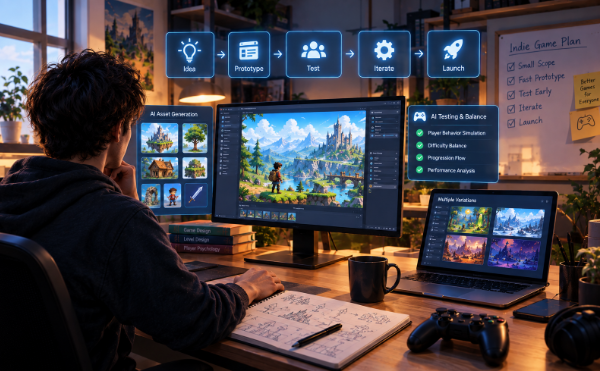
Indie game development has always been a game of trade-offs. Small teams and solo creators rarely have the time, money, or manpower that larger studios can throw at a project, which means every decision carries more weight. AI has started shifting that balance in a meaningful way, giving indie creators access to workflows that used to require resources far beyond what a single person or small team could realistically pull together.
Why Indie Creators Need a Different Approach Than Studios
Limited Resources Demand Sharper Prioritization
A large studio can afford to explore multiple directions in parallel and abandon the ones that don’t work. An indie creator usually can’t absorb that kind of waste, which means every hour spent needs to count more. This makes speed and focus far more valuable to indie creators than they are to teams with bigger budgets to fall back on.
Solo Creators Wear Every Hat at Once
Where a studio splits work across specialists, an indie creator is often designer, artist, programmer, and marketer simultaneously. Any tool that reduces the burden of one of those roles frees up meaningful time and energy for the others, which is exactly where AI has made the biggest practical difference.
Core AI Strategies for Indie Development
Use AI to Compress the Idea-to-Prototype Timeline
The single biggest advantage AI offers indie creators is cutting the time between having an idea and having something playable. Instead of spending weeks building basic systems before a concept can even be tested, AI-assisted tools let a creator get a rough version playable quickly enough to judge whether the core idea is actually fun before investing further.
Lean on AI for Repetitive Production Work
Tasks like generating asset variations, background elements, or repetitive content take real time when done manually, and that time adds up fast for a solo creator. AI handling this repetitive production work frees up hours that can go toward the decisions that actually require a human eye, like pacing, tone, and overall design direction.
Test More Ideas Instead of Committing Early
Because AI lowers the cost of prototyping, indie creators can afford to test several different directions before settling on one, rather than committing early simply because starting over would otherwise be too expensive. This reduces the risk of investing months into an idea that never quite works.
Where AI Fits Into a Realistic Indie Workflow
Brainstorming and Concept Validation
AI is useful early in the process for generating variations on a theme or mechanic, giving a creator more to react to than a blank page would provide. This works best when paired with quick prototyping, since the real value comes from testing which brainstormed idea actually holds up in play.
Building and Iterating Without a Technical Team
For indie creators without a programming background, AI-assisted no-code tools remove what used to be the single largest barrier to actually building a game. Describing a mechanic and seeing it implemented quickly replaces what used to require either learning to code or finding a technical collaborator.
Refining Based on Player Reactions
Once a rough version exists, AI can help simulate broader testing scenarios and highlight obvious balance or design issues before a small pool of real playtesters ever sees the game, making limited access to testers go further than it otherwise would.
A Platform Built With Indie Creators in Mind
Having the conceptual benefits of AI-assisted development only matters if there’s an actual platform that lets a solo creator work this way in practice.
Designed Around Fast, Independent Creation
Astrocade is a good example of an AI game maker built specifically to support indie creators working without a larger team behind them. It allows a creator to describe an idea, get it into a playable state quickly, and iterate based on direct testing rather than depending on a full development pipeline.
Seeing an Indie-Style Concept in a Real Game
Jump to Collect Football Legends is a good example of a focused, hook-driven concept that fits well within an indie creator’s realistic scope. Games built around a clear, simple premise like this tend to be well suited to the kind of fast, iterative development AI-assisted tools support, rather than requiring a large production pipeline to execute well.
What AI Doesn’t Solve for Indie Creators
It Doesn’t Replace a Strong Creative Vision
AI can accelerate production and testing, but it can’t tell a creator what makes their specific idea worth pursuing in the first place. That creative spark, and the judgment to recognize when it’s genuinely there, still has to come from the person building the game.
It Doesn’t Guarantee an Idea Is Good
Faster prototyping means bad ideas get identified more quickly, but it doesn’t turn a weak concept into a strong one. Indie creators still need the discipline to walk away from an idea that isn’t working, even after AI has made it easy to build.
It Doesn’t Replace Real Player Feedback
Simulated testing and AI-assisted iteration are useful early filters, but they don’t fully substitute for reactions from real players. Indie creators still need to get their games in front of actual people to validate whether something that works in testing also works in practice.
Common Mistakes Indie Creators Make With AI Tools
Over-Polishing Before Validating the Core Idea
It’s tempting to make a prototype look finished once AI tools make that easy, but polishing an idea that hasn’t been validated yet risks wasting time on a concept that might not survive playtesting anyway.
Trying to Do Too Much at Once
Access to faster tools can tempt indie creators into attempting more ambitious projects than they can realistically finish. Staying disciplined about scope remains just as important with AI-assisted development as it was without it.
Skipping Outside Feedback Because Iteration Feels Productive
Because it’s satisfying to keep adjusting a project directly, it’s easy to delay bringing in outside testers longer than necessary, mistaking personal comfort with a build for evidence that it’s actually working for others.
A Practical AI-Assisted Workflow for Indie Creators
A reasonable approach looks like this. Start with a small, focused concept rather than an ambitious one, and use AI-assisted tools to get a rough version playable as quickly as possible. Test that rough version with real people early, rather than polishing it first. Use AI to handle repetitive production work once the core idea is validated, freeing up time for the design decisions that actually require a human eye. Stay disciplined about scope throughout, resisting the temptation to expand simply because the tools make it easier to keep adding.
Final Thoughts
AI hasn’t leveled every part of the playing field between indie creators and larger studios, but it has meaningfully closed the gap in areas that used to require resources small teams simply didn’t have. For indie creators willing to stay focused and lean on these tools for speed rather than as a substitute for creative judgment, there’s rarely been a more realistic path from idea to finished game.
